Defend Against AI-Driven Attacks with Privileged Access Security
AI is increasing the speed at which both businesses and attackers operate. Automated reconnaissance, credential attacks, compromised identities, and machine-speed lateral movement can turn excessive privilege into a serious security risk.
OmniPriv delivers AI threat protection at the privileged-access layer. By combining Just-in-Time access, Zero Standing Privileges, credential protection, intelligent behavioral analysis, session control, and automated response, OmniPriv helps contain threats before privileged access becomes a wider breach.
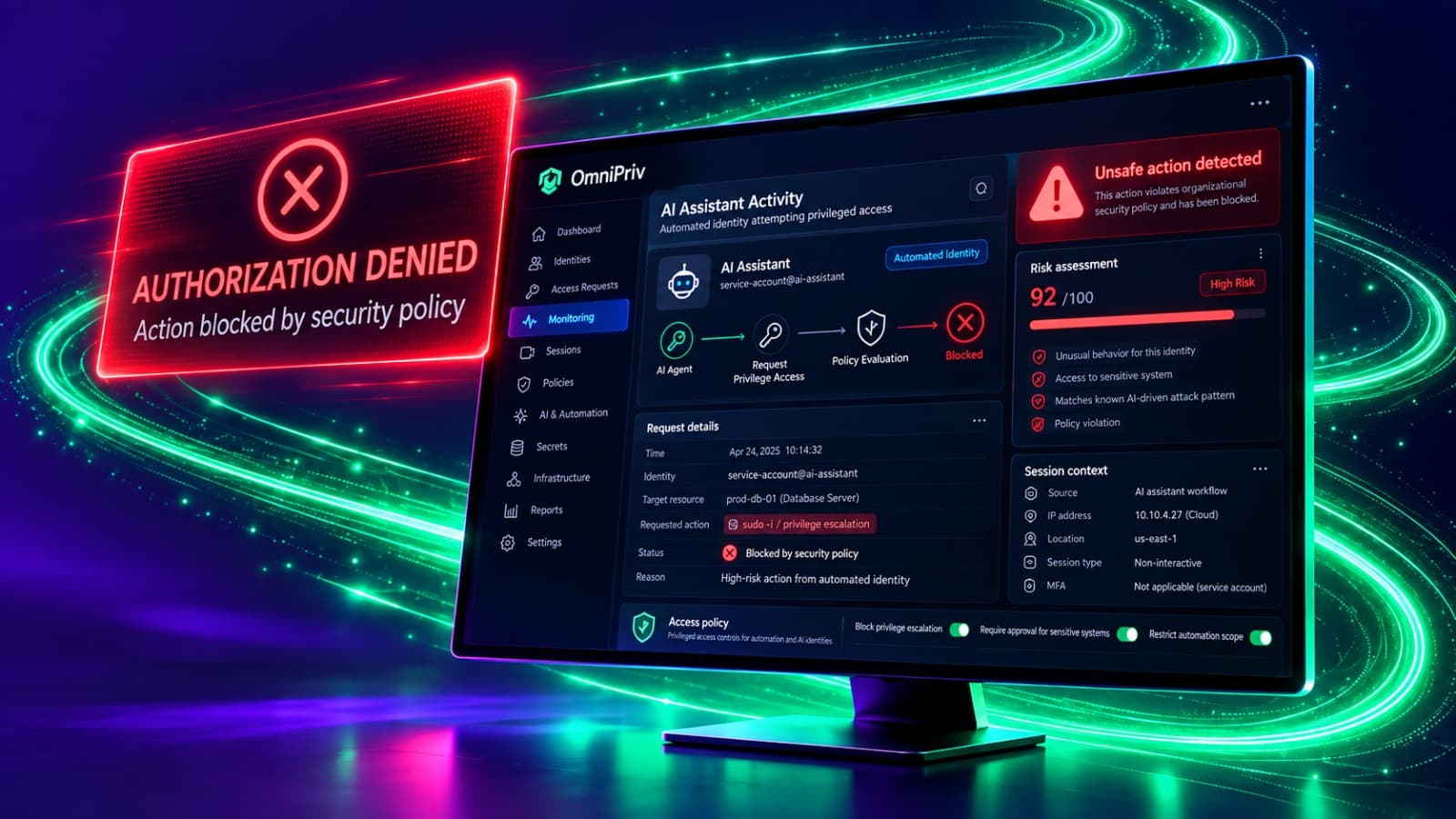
AI-Driven Attacks Turn Identity into a High-Value Target
Attackers do not always need to break through every security layer. A single compromised identity with excessive privilege may already provide access to critical infrastructure.
The risk grows as enterprises introduce AI agents, automation, machine identities, cloud workloads, and increasingly connected systems.
Effective identity threat protection therefore needs to control what happens after authentication — not simply verify a login.
OmniPriv applies policy-driven Privileged Access Management across human, machine, vendor, and AI identities, helping organizations control how privileged access is granted, used, monitored, and revoked.

Reduce the Privilege an Attacker Can Exploit
Permanent administrator access gives attackers more opportunity if an account or credential is compromised. OmniPriv uses just-in-time privileged access to provide temporary, task-specific permissions that automatically expire.
Move Toward Zero Standing Privileges
With Zero Standing Privileges, elevated permissions do not remain available simply because someone may need them later. This helps reduce:
- Persistent administrator rights
- Unnecessary privileged access
- Stale access paths
- Excessive permissions
- Privilege available to compromised identities
Just-in-time access is already a core part of OmniPriv's privileged-access model for both human and automated identities.
Protect the Credentials Attackers Want
Credentials remain a critical target in AI-driven cyber attacks.
Passwords, SSH keys, API tokens, and privileged secrets can provide direct access to sensitive infrastructure if they are exposed or remain valid for too long.
OmniPriv strengthens privileged credential protection through encrypted vaulting and automated rotation. Passwords, SSH keys, and API tokens can be rotated automatically on schedule or after privileged sessions. This reduces reliance on long-lived secrets and limits the value of stolen credentials.

Detect Privileged Threats with AI and Machine Learning
Stopping modern attacks requires more than static access rules. OmniPriv's AI threat protection uses machine-learning-based behavioral analysis to identify activity that differs from expected privileged behavior. The platform can detect patterns such as:
- Unusual commands
- Abnormal access times
- Unexpected data volumes
- Credential harvesting
- Privilege abuse
- Lateral movement
- Attempts to bypass PAM controls
OmniPriv's AI-PAM engine also uses IsolationForest-based anomaly scoring across privileged sessions and supports automated escalation and blocking based on risk.

AI threat protection you can point at
Detection is not a dashboard screenshot. These are the controls running behind it.
Contain Threats Before They Move Further
Detection has limited value if risky activity can continue unchecked.
OmniPriv combines privileged access threat detection with access controls and session intervention to help contain suspicious activity.
When an identity begins behaving unexpectedly, security teams can investigate the activity, restrict access, and terminate risky privileged sessions.
This provides an additional layer of lateral movement prevention by reducing how freely compromised identities can move between sensitive resources.

Monitor What Happens After Access Is Granted
A successful login should never mean unlimited trust.
OmniPriv provides privileged session monitoring across SSH, RDP, VNC, HTTP, and database access. Sessions can be recorded, isolated, searched, and controlled throughout their lifecycle.
Session controls can also restrict specific actions and trigger automated responses when defined security events occur.
Protect AI Agents with Deterministic Privilege Controls
AI agents can operate faster and more autonomously than traditional users. That makes AI agent security an important part of modern PAM.
OmniPriv gives AI and automated identities controlled privilege boundaries rather than unrestricted authority. Its current AI-PAM capabilities include:
- Per-agent identities
- Tool allowlists
- Scoped access
- Human approval for high-risk actions
- Policy verification
- Agent session audit trails
Even when AI reasoning is influenced by unsafe input, privileged actions can remain subject to deterministic access policies.
See how AI-PAM governs agent privilegeOne AI Threat Protection Model Across Every Identity
Modern attacks can involve humans, machines, vendors, service accounts, or autonomous agents. OmniPriv brings these identities under one privileged-access security model.
Verify
Authenticate and assess every privileged access request.
Limit
Apply least privilege and time-bound permissions.
Protect
Vault and rotate privileged credentials.
Monitor
Record sessions and privileged activity.
Detect
Use behavioral analytics to identify suspicious patterns.
Respond
Alert, restrict, or terminate risky activity.
Audit
Maintain tamper-resistant evidence for investigations and compliance.
This gives organizations AI security monitoring and privileged-access control from a unified platform rather than disconnected security tools.
Stop AI-Driven Threats from Becoming Privileged Breaches
Organizations cannot prevent every identity from being targeted. They can control how much privilege that identity holds and how far an attacker can move if it is compromised.
OmniPriv AI threat protection combines Zero Trust PAM, JIT privileges, credential security, behavioral analytics, real-time session visibility, and automated response to reduce the impact of AI-driven attacks.
Reduce standing privilege. Detect abnormal behavior. Contain risky access. Maintain complete accountability.
Frequently Asked Questions
Common questions about AI threat protection, privileged access threat detection and containing AI-driven attacks.
AI threat protection uses security controls, behavioral analytics, access policies, and automated response to identify and limit threats involving AI-powered attacks, compromised identities, automation, and privileged access.
PAM limits the privilege an attacker can inherit. JIT access, credential protection, session monitoring, least privilege, and threat detection can reduce what a compromised identity is able to access or do.
OmniPriv uses machine-learning behavioral analysis and anomaly detection to identify unusual command patterns, access times, data volumes, privilege abuse, credential harvesting, and lateral movement.
Zero Standing Privileges reduce permanent elevated access. If an identity is compromised while it does not hold unnecessary administrative rights, the attacker has fewer privileges immediately available to exploit.
Yes. OmniPriv currently provides controls for AI and automated identities including scoped privileges, policy enforcement, JIT access, human approval for high-risk actions, and agent activity auditing.
Yes. OmniPriv supports behavioral alerts, session controls, real-time intervention, and automated session termination for detected security events.