Best Privileged Access Management Use Cases in 2026
Explore the top privileged access management use cases in 2026 — from securing administrator accounts and enforcing least privilege to Zero Trust integration and managed PAM services.
Introduction to Privileged Access Management
Cyber threats are rising every year. Therefore, businesses must protect sensitive systems with strong controls. Privileged access management use cases show how organizations secure critical assets. These solutions control who can access high-level systems. As a result, companies reduce risk and improve visibility.
Modern environments require advanced protection. Cloud adoption is growing fast. Remote work is now standard. Consequently, privileged accounts become prime targets for attackers. Organizations must act early to prevent breaches. To understand the full scope of what PAM protects, see our complete guide to privileged access management.
Why Privileged Access Management Matters
Privileged accounts hold the highest level of control. Hackers often target these accounts first. Therefore, securing them is critical. Privileged access management use cases help prevent unauthorized access. They also enforce strict identity controls.
In addition, companies gain better monitoring. Every session is tracked in real time. This improves accountability across teams. Furthermore, businesses meet compliance requirements more easily. Our analysis of 2025's biggest privileged account breaches confirms that in 89% of cases, compromised privileged credentials were the root cause.
Top Privileged Access Management Use Cases
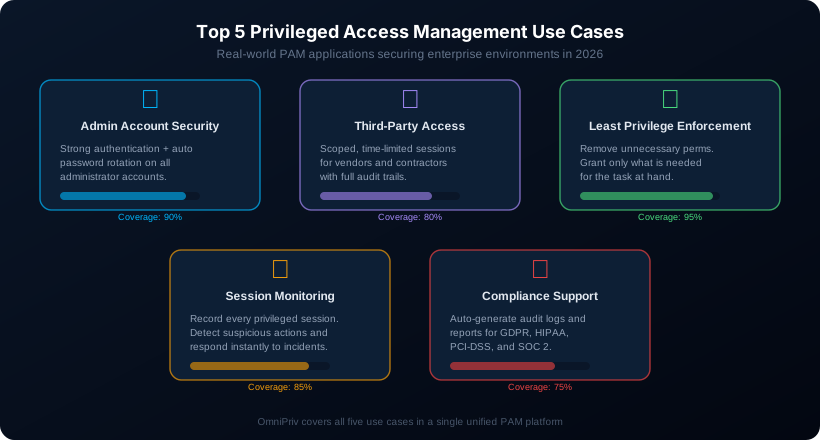
1. Securing Administrator Accounts
Administrators control systems and networks. Therefore, their access must be tightly managed. PAM tools protect these accounts with strong authentication. They also rotate passwords automatically. As a result, risks decrease significantly. For a deep-dive on how automated rotation eliminates lateral movement, see our guide on SSH key management at scale.
2. Managing Third-Party Access
Vendors often need temporary access. However, unmanaged access creates security gaps. PAM ensures limited and monitored sessions. This reduces exposure to external threats. Time-scoped, approval-gated access means vendors get exactly what they need — nothing more, and only for as long as the task requires.
3. Enforcing Least Privilege Access
Users should only access what they need. This is a core security principle. PAM enforces this rule effectively. Therefore, unnecessary permissions are removed. Stale privileged accounts with forgotten permissions are one of the most exploited attack vectors — automated discovery and lifecycle management eliminate this risk entirely.
4. Monitoring Privileged Sessions
Session recording adds visibility. Security teams can review user actions easily. This helps detect suspicious activity early. Consequently, incidents are handled faster. Combined with AI-powered anomaly detection — as introduced in OmniPriv 4.0 — session monitoring becomes a proactive defense layer rather than a reactive audit tool.
5. Supporting Compliance Requirements
Regulations demand strict access control. PAM solutions simplify audits. They provide logs and reports instantly. As a result, compliance becomes easier to manage. Whether your obligation is SOC 2 Type II, HIPAA, or PCI-DSS, a mature PAM deployment produces the evidence auditors require automatically.
Privileged Access Management as a Service
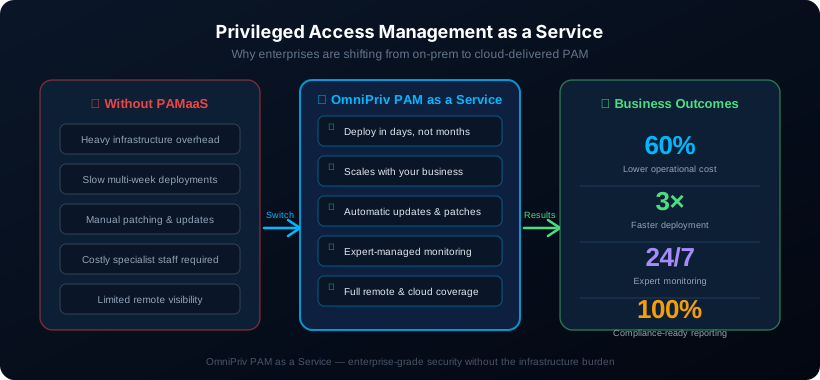
Many businesses now prefer cloud-based security. Privileged access management as a service offers flexibility and scalability. Companies avoid complex infrastructure setup. Instead, they deploy PAM quickly.
Additionally, managed services reduce operational burden. Experts handle updates and monitoring. This ensures continuous protection. Organizations are adopting this model rapidly as cloud and remote-first architectures become standard. OmniPriv provides reliable PAM services tailored for modern enterprises — for a detailed comparison of cloud-delivered versus on-premises PAM, see our PAM as a Service guide.
Zero Trust and PAM Integration
Zero Trust is now essential for cybersecurity. It assumes no user is trusted by default. Therefore, every request must be verified. Many organizations ask which privileged access management Zero Trust model is best.
The answer depends on integration capabilities. Strong PAM solutions support Zero Trust frameworks. They verify identity before granting access. Moreover, they monitor behavior continuously. This combination creates a powerful defense system. For a step-by-step enterprise implementation guide, see How to Implement Zero-Trust PAM.
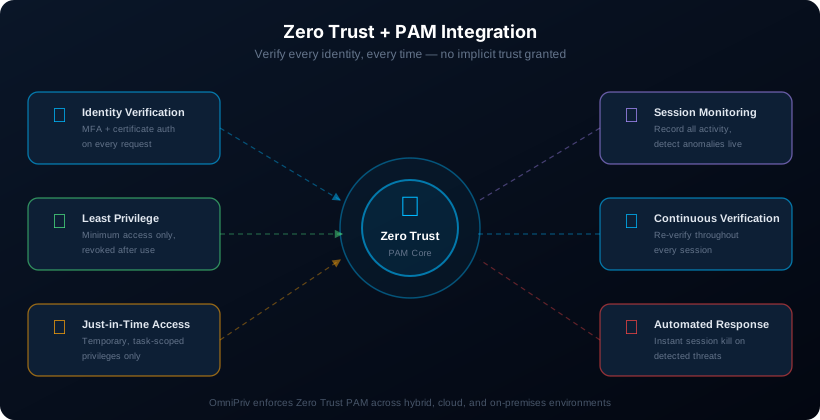
Just-in-time access is a cornerstone of Zero Trust PAM — eliminating standing privileges so that even if credentials are compromised, attackers find no persistent foothold. Our dedicated JIT access guide covers this in detail.
Privileged Access Management Best Practices
Organizations must follow proven strategies. Privileged access management best practices ensure long-term security success:
- Use multi-factor authentication for all privileged users
- Rotate credentials regularly and automatically
- Monitor and record all privileged sessions
- Limit access based on roles and business need
- Conduct regular security audits and access reviews
These practices improve control and reduce risks. Furthermore, they align with global security standards. See our top PAM best practices for 2026 for a complete breakdown of each control and how to implement it.
OmniPriv PAM Solutions
Businesses need strong cybersecurity solutions that scale with growth. OmniPriv delivers advanced PAM solutions for enterprises. Their platform offers real-time monitoring and secure access control.
Additionally, OmniPriv integrates with Zero Trust models. This enhances security across cloud and on-premise systems. Companies can protect sensitive data efficiently. Moreover, the solution scales with business growth.
For organizations seeking reliable protection, OmniPriv provides a complete package. It combines innovation with proven security strategies. If you are building an internal business case for PAM investment, our PAM business case framework gives you the financial and risk language to secure executive buy-in.
Conclusion
Cybersecurity threats are evolving rapidly. Therefore, businesses must adopt modern solutions. Privileged access management use cases highlight the importance of controlling sensitive access. From securing admin accounts to enabling Zero Trust, PAM plays a critical role.
Organizations should follow best practices and adopt managed services. With solutions like OmniPriv, businesses can stay protected. Now is the time to strengthen access security and reduce risks.
FAQs
What are privileged access management use cases? They are real-world applications where PAM secures high-level access to systems and data — including admin account protection, third-party access control, least privilege enforcement, session monitoring, and compliance automation.
What is privileged access management as a service? It is a cloud-based PAM solution that provides enterprise-grade security without complex on-premises infrastructure, managed by expert teams around the clock.
Which privileged access management Zero Trust model is best? The best solution integrates identity verification, continuous session monitoring, and least privilege access — verifying every request regardless of network location.
Why are privileged access management best practices important? They help reduce risks, improve compliance, and strengthen overall security by ensuring that privileged access is always controlled, monitored, and auditable.
How does PAM improve cybersecurity? PAM controls access, monitors activity, prevents unauthorized system usage, and provides the audit evidence needed to satisfy regulatory requirements.
See OmniPriv in Action
Talk to our team to see how OmniPriv addresses the challenges in this article for your specific environment.