Secure AI Agents with Privileged Access Management
AI agents are becoming active identities inside enterprise environments. They can call tools, access databases, interact with cloud infrastructure, use credentials, and perform actions faster than a human can review manually.
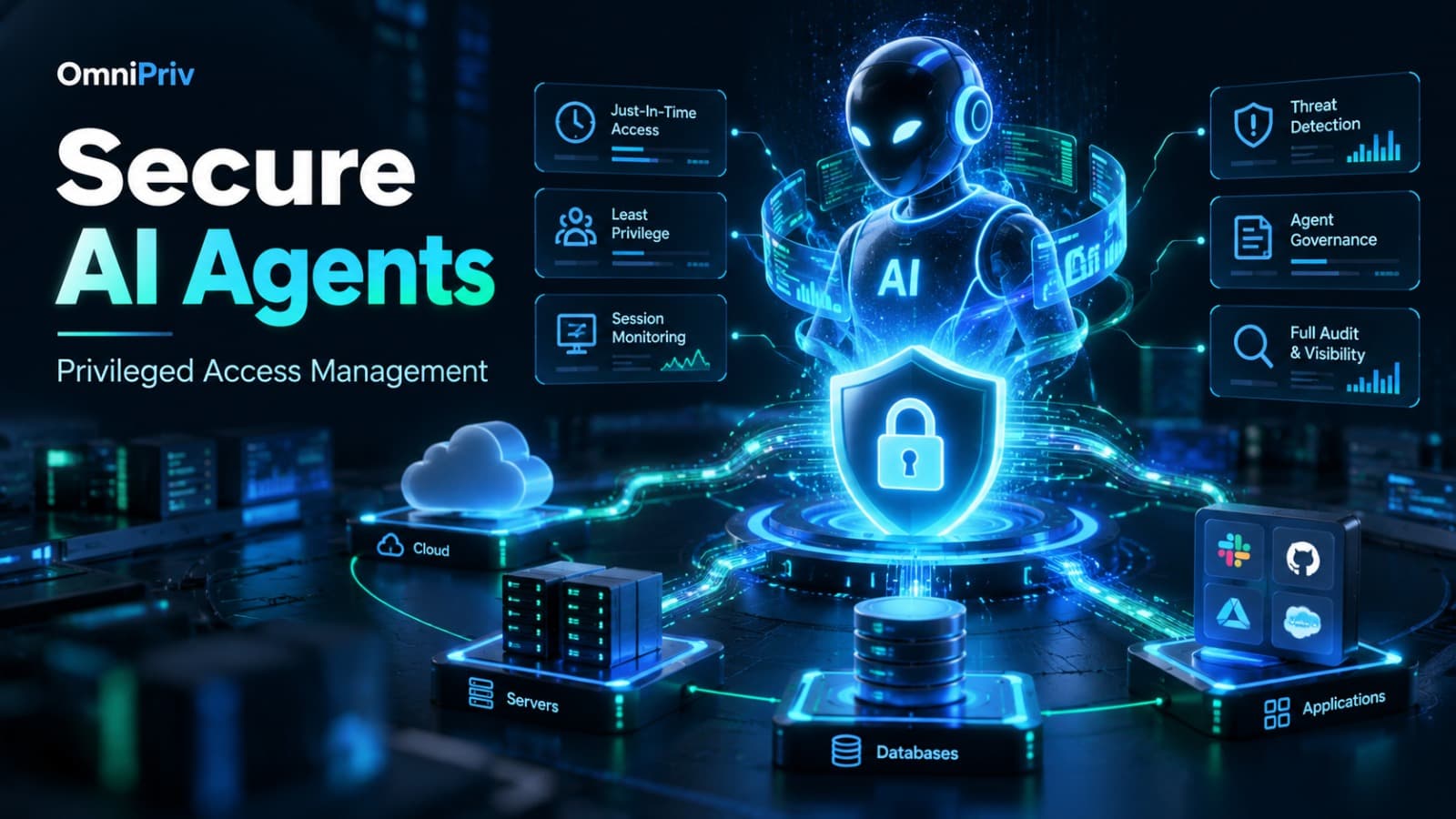
OmniPriv helps organizations secure AI agents by bringing autonomous access under the same Privileged Access Management principles used to protect sensitive human and machine identities.
Control what AI agents can access, how much privilege they receive, how long that privilege lasts, and what happens after access is granted.
AI Changes Who Can Hold Privileged Access
Traditional PAM focused primarily on administrators.
Modern environments now include people, applications, workloads, service accounts, automation, and autonomous AI agents. Each can potentially interact with privileged systems.
OmniPriv applies one identity-security model across human, machine, vendor, and AI identities rather than managing each category through disconnected controls.
Effective AI agent security therefore starts with a simple question:
What should this identity be allowed to do right now?

Control AI Agent Access with Zero Trust PAM
Authentication alone does not determine whether an AI agent should be allowed to perform a privileged action.
OmniPriv combines identity verification with policy-based authorization so organizations can control:
- Which tools an agent may call
- Which systems it may access
- Which data it may reach
- Which privileged actions require approval
- How long elevated access remains active
OmniPriv's AI-agent governance model includes per-agent identities, explicit tool allowlists, bounded data scopes, and human approval for higher-risk actions.
Apply JIT Access Instead of Permanent Privilege
Permanent access gives compromised or misconfigured agents more authority than necessary.
JIT access for AI agents provides privilege only when an approved task requires it and removes that privilege afterward.
This supports least privilege and Zero Standing Privileges, reducing the amount of privileged access continuously available to human and autonomous identities.
Keep Credentials Out of AI Workflows
AI agents may need to reach databases, APIs, servers, cloud services, or enterprise applications.
That does not mean they should permanently possess privileged passwords, SSH keys, or tokens. Strong AI credential security keeps secrets behind controlled infrastructure and provides credentials only when required.
OmniPriv combines privileged credential management with temporary access and agent-specific controls so automated identities can use approved resources without relying on shared human accounts or unmanaged long-lived secrets. OmniPriv's broader platform includes credential vaulting and privileged-access lifecycle controls.

Monitor Every Privileged AI Session
Access decisions are only one part of the security lifecycle. Organizations must also understand what happened after an AI agent received permission.
OmniPriv records agent activity and privileged sessions so security teams can investigate what an identity accessed, which actions were performed, and whether unusual behavior occurred.
Its AI-agent governance model is specifically designed around visibility, runtime enforcement, credential protection, and session accountability. This makes privileged session monitoring an important part of AI accountability.

Detect AI-Driven Risk in Real Time
Static policies cannot identify every abnormal behavior pattern.
OmniPriv's AI-PAM engine applies machine-learning-based anomaly detection to privileged activity. Its current architecture documents IsolationForest analysis, multiple behavioral features, risk scoring, escalation, and automated blocking workflows. This helps security teams identify situations such as:
- An identity behaving differently from its normal pattern
- Unexpected privileged commands
- Unusual access times
- Excessive data activity
- Attempts to misuse privileged access
AI does not replace PAM controls. It adds additional context to them.
Govern Agentic AI with Clear Boundaries
Agentic identity security requires clear boundaries around autonomous behavior. Every AI agent should have:
A unique identity
Not a borrowed human account — the agent has its own verifiable identity.
A defined tool scope
Only approved tools and systems, refused at policy evaluation otherwise.
A bounded data scope
Only information required for the task in front of it.
Temporary privilege
No unnecessary standing access left available to inherit.
Human approval
Required before designated high-risk actions execute.
Recorded activity
So actions remain explainable and auditable.
Secure AI Across Enterprise Infrastructure
AI agents rarely operate in isolation. They may interact with:
Cloud environments
AWS, Azure, GCP, Kubernetes, workloads, and cloud-native services.
Databases
Production data stores and privileged database accounts.
Applications and APIs
Enterprise tools, internal services, and automated integrations.
DevOps environments
CI/CD pipelines, infrastructure automation, repositories, and secrets.
Why OmniPriv for AI Privileged Access?
OmniPriv brings AI security back to a familiar security principle: no identity should receive more privilege than it needs, for longer than it needs it. The platform combines:
- Discover identities and privileges
- Control access with JIT, MFA, policies, and Zero Standing Privileges
- Protect privileged credentials
- Monitor sensitive sessions
- Detect abnormal behavior
- Govern AI-agent tools and data access
- Audit privileged activity
This creates a unified approach to AI privileged access management instead of adding another disconnected AI security tool.
Governance you can point at
Agent security is not a policy document. These are the controls running behind it.
Secure AI Without Giving AI Unlimited Privilege
AI should be able to work quickly without operating outside enterprise security boundaries.
OmniPriv helps organizations secure AI agents with Privileged Access Management, JIT privileges, credential protection, AI-agent governance, behavioral threat detection, and complete session accountability.
Every identity verified. Every privilege scoped. Every sensitive action visible.
Frequently Asked Questions
Common questions about securing AI agents, agentic identity security and governing privileged AI access.
To secure AI agents means controlling their identities, permissions, credentials, tools, data access, privileged actions, and activity records so autonomous systems cannot operate with unrestricted enterprise access.
AI agent security protects autonomous AI identities against excessive privilege, compromised credentials, unsafe tool use, unauthorized data access, and uncontrolled actions.
PAM gives organizations a way to apply least privilege, JIT access, credential controls, approvals, session monitoring, and auditability to AI identities just as they would to privileged human administrators.
Agentic Identity Security governs autonomous AI identities as independent actors rather than treating them as extensions of human accounts. Each agent should have its own identity, permissions, scope, and audit history.
Yes. OmniPriv's AI-agent governance capability supports human approval before designated high-risk actions execute, with multi-approver chains and no self-approval.
Yes. OmniPriv documents machine-learning-based privileged activity analysis using its AI-PAM engine, including behavioural anomaly scoring and automated escalation or blocking.