Zero Trust PAM in Saudi Arabia: How JIT Access Reduces Privileged Account Risk
Learn how Zero Trust PAM and JIT access reduce privileged account risk, enforce least privilege, and support Saudi NCA-aligned security controls.
Zero Trust PAM in Saudi Arabia: Reducing Standing Privileges
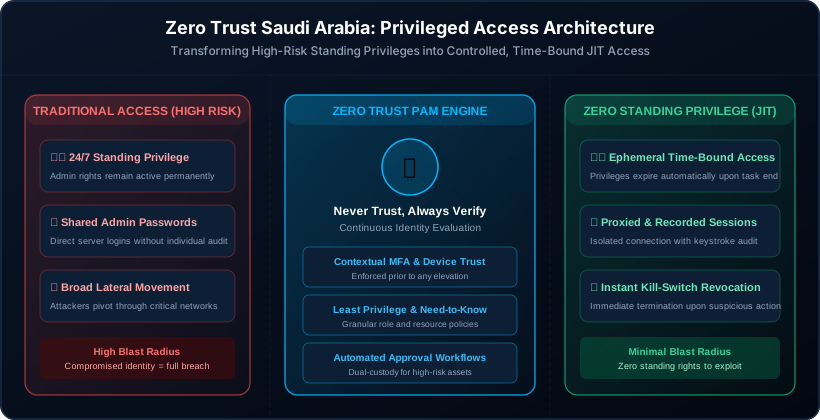
Privileged accounts can change system configurations, access sensitive data, and control critical infrastructure. When these permissions remain active continuously, compromised credentials can give attackers a direct path to high-value systems. For organizations developing a Zero Trust Saudi Arabia strategy, reducing standing privilege should therefore be a key security priority.
Zero Trust PAM applies the principle of continuous verification to administrators, vendors, service accounts, and other privileged identities. Rather than trusting users because of their role or network location, privileged access is verified, authorized, restricted, and monitored.
Organizations building their PAM foundation can start with OmniPriv’s complete introduction to Privileged Access Management.
Why Zero Trust Saudi Arabia Strategies Need JIT Access
Traditional access models often provide administrators with permanent elevated permissions because they may need them later. The security problem is simple: unused privileges remain available to attackers as well.
Just-in-time privileged access changes this model. A user requests elevated access to a specific resource for a defined purpose. Following authentication and any required approval, privileges are granted temporarily and removed when the authorized period ends.
For organizations evaluating JIT access Saudi Arabia, this approach can significantly reduce exposure created by persistent administrator rights. OmniPriv’s Just-In-Time Access Guide provides a deeper explanation of replacing standing privilege with time-bound access.
Effective JIT access should answer four questions: who needs access, what resource is required, why access is needed, and how long it should remain active. Combined with authentication, approvals, credential security, and monitoring, JIT becomes an important component of Zero Trust PAM.
JIT Access, Least Privilege, and NCA Cybersecurity Controls
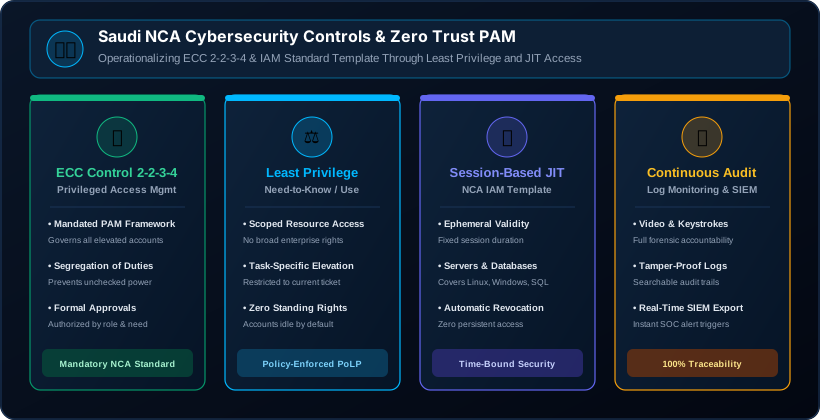
Saudi Arabia’s National Cybersecurity Authority addresses privileged access within its cybersecurity guidance. The ECC implementation guidance includes control 2-2-3-4 for privileged access management and also addresses need-to-know, need-to-use, least privilege, segregation of duties, approvals, and monitoring of privileged-account activity.
NCA’s Identity and Access Management Standard Template also describes a PAM solution enforcing session-based temporary access to systems including servers, databases, and logging systems.
For security teams researching least privilege NCA requirements, the important principle is that elevated permissions should be tied to legitimate business needs and governed throughout their lifecycle.
A Zero Trust Saudi Arabia approach can help operationalize this principle by replacing unnecessarily broad, permanent administrator rights with controlled access. JIT limits how long privilege exists, while PAM provides authentication, authorization, credential protection, monitoring, and accountability.
For implementation guidance, see OmniPriv’s step-by-step Zero-Trust PAM guide.
What Should a PAM Solution in KSA Provide?
A PAM solution in KSA should do more than store privileged passwords. Enterprises need security controls covering the complete privileged-access lifecycle across servers, databases, applications, cloud infrastructure, and remote administration.
Important capabilities include: - JIT access with automatic expiration - Role- and policy-based access controls - Secure credential management - MFA and approval workflows - Privileged session monitoring and recording - Searchable activity logs and audit trails - Rapid access revocation and session termination
The OmniPriv enterprise PAM platform brings privileged-access capabilities together across enterprise environments. Its Privileged Session Management capabilities provide recording, isolation, monitoring, searchable session history, and session controls, while Audit, Reporting & Compliance provides privileged-account traceability and reporting.

Reducing Privileged Risk Without Slowing IT Operations
Zero Trust should not prevent legitimate administration. Its purpose is to remove unnecessary trust.
With carefully designed JIT policies, routine requests can follow predefined workflows while high-risk systems receive stronger authentication and approval requirements. Permissions expire automatically instead of remaining active until someone manually removes them.
For Zero Trust Saudi Arabia initiatives, this creates a balance between security and productivity: administrators receive the privileges required to complete approved work without maintaining permanent high-level access.
Strengthen Privileged Access with OmniPriv in Saudi Arabia
A Zero Trust Saudi Arabia strategy becomes stronger when privileged access is temporary, verified, controlled, and auditable. OmniPriv combines JIT provisioning, credential management, policy-driven access, session visibility, and audit capabilities to help enterprises reduce standing privileged access.
Explore the OmniPriv PAM platform and see how a modern Zero Trust PAM approach can strengthen privileged-access security across your organization.
Frequently Asked Questions (FAQs)
What is Zero Trust PAM?
Zero Trust PAM applies verification, least privilege, authorization policies, and monitoring to privileged access. Administrative status or internal network location does not automatically create trusted access.
What is just-in-time privileged access?
Just-in-time privileged access provides elevated permissions only when required and removes them after an approved task or access window. This reduces standing privilege and limits exposure if an account is compromised.
Does NCA guidance address privileged access management?
Yes. NCA guidance addresses privileged access management, least privilege, privileged accounts, approvals, authentication, and monitoring. Organizations should assess which NCA controls apply to their own regulatory and operating environment.
Is JIT enough for a Zero Trust Saudi Arabia strategy?
No. JIT is one important control. Effective Zero Trust also requires authentication, secure credential management, access policies, monitoring, audit logs, access reviews, and incident-response processes.
See OmniPriv in Action
Talk to our team to see how OmniPriv addresses the challenges in this article for your specific environment.