
On this page
- Introduction
- What Is Privileged Access Management?
- Why Is Privileged Access So Important?
- Key Privileged Access Management Benefits
- Reducing the Risk of Credential-Based Attacks
- How PAM Solutions Strengthen Cybersecurity
- Business Requirements for Privileged Access Management
- PAM and Zero Trust Security
- Improving Compliance and Accountability
- Choosing the Right PAM Strategy
- Conclusion
- Frequently Asked Questions (FAQs)
Introduction
In modern cybersecurity, not every user has the same level of access. Some employees, administrators, developers, and third-party vendors have permissions that allow them to make critical changes to systems and access sensitive data. These privileged accounts are powerful, which also makes them attractive targets for cybercriminals. This is where the importance of privileged access management becomes clear. Privileged Access Management, commonly known as PAM, helps organizations control, monitor, and secure accounts with elevated permissions. Rather than giving permanent and unrestricted access, organizations can apply stronger authentication, approval processes, monitoring, and access controls. As businesses continue adopting cloud platforms, remote work, and complex IT environments, protecting privileged access has become a fundamental part of cybersecurity strategy.
What Is Privileged Access Management?
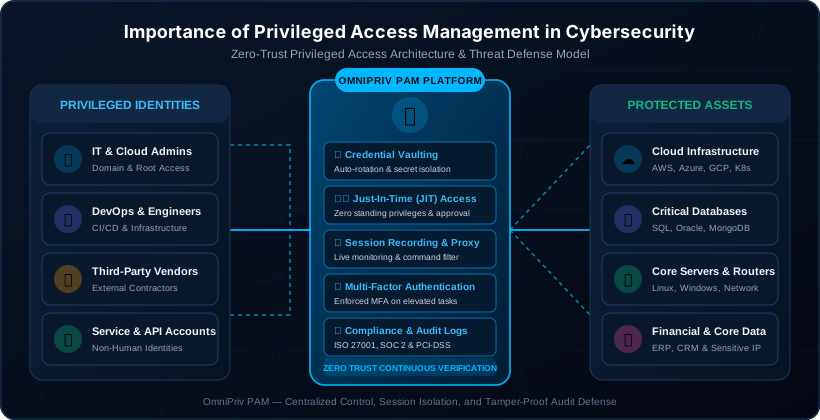
Privileged Access Management is a cybersecurity approach designed to control and monitor access to critical systems and sensitive resources. Privileged accounts can include system administrators, database administrators, cloud administrators, service accounts, and other identities with elevated permissions. If these accounts are compromised, attackers may gain access to an organization's most valuable digital assets.
NIST describes privileged accounts as having elevated and sometimes unrestricted access, making them valuable targets for both external and internal malicious actors. PAM solutions help reduce this risk by providing organizations with greater visibility and control over who accesses sensitive systems and when that access is used.
Why Is Privileged Access So Important?
Imagine giving someone a master key that opens every room in a building. If that key is lost or stolen, the potential damage can be enormous. Privileged credentials work in a similar way. They can provide access to critical infrastructure, confidential information, financial systems, and security configurations.
The importance of privileged access management continues to grow because traditional security models often rely too heavily on trust. Modern cybersecurity strategies increasingly focus on verifying users and controlling access continuously. NIST's Zero Trust Architecture guidance emphasizes protecting resources and avoiding implicit trust based solely on network location or account ownership.
Key Privileged Access Management Benefits
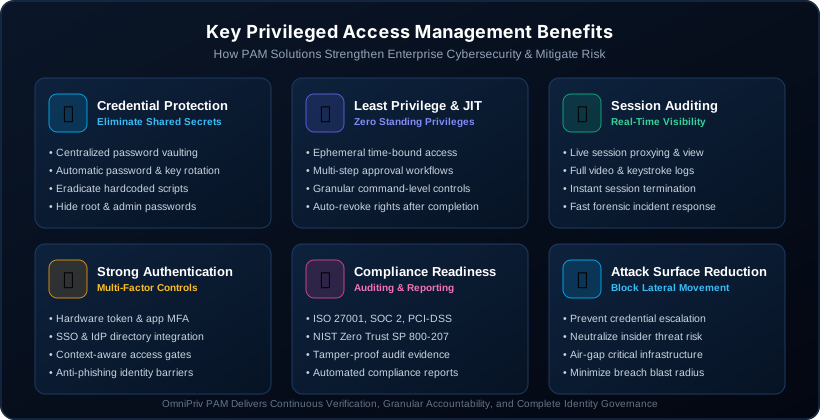
One of the most important privileged access management benefits is reducing the risk of credential misuse. PAM platforms can store privileged credentials securely instead of allowing passwords to be openly shared between administrators or teams.
Other major benefits include:
- Improved control over privileged accounts
- Reduced risk of unauthorized access
- Better visibility into administrative activity
- Stronger authentication and access approval processes
- Session monitoring and auditing
- Support for compliance and security requirements
These capabilities allow security teams to investigate suspicious activity and understand how privileged accounts are being used.
Reducing the Risk of Credential-Based Attacks
Attackers often look for weaknesses that provide a path into valuable systems. Although the cyber threat landscape continues to evolve, identity and access security remain essential to protecting organizations.
According to Verizon's 2026 DBIR findings, vulnerability exploitation became the leading breach entry point, accounting for 31% of breaches in the reported dataset, while the broader threat landscape continues to demand strong security fundamentals. PAM should therefore be part of a broader cybersecurity strategy that protects privileged identities, limits unnecessary access, and improves visibility across critical systems.
This demonstrates the importance of privileged access management as part of a layered security approach rather than a standalone solution.
How PAM Solutions Strengthen Cybersecurity
Effective PAM solutions work by creating stronger controls around privileged accounts. Instead of allowing users to maintain unlimited access indefinitely, organizations can define when access is needed and under what conditions it should be granted.
Many PAM implementations support principles such as least privilege and just-in-time access. These approaches help organizations provide users with only the permissions required to complete a specific task. Once the task is completed, elevated access can be removed or restricted.
This reduces the organization's attack surface and limits the potential impact of compromised credentials. The importance of privileged access management becomes especially significant in large organizations where hundreds or thousands of privileged identities may exist across cloud and on-premises environments.
Business Requirements for Privileged Access Management
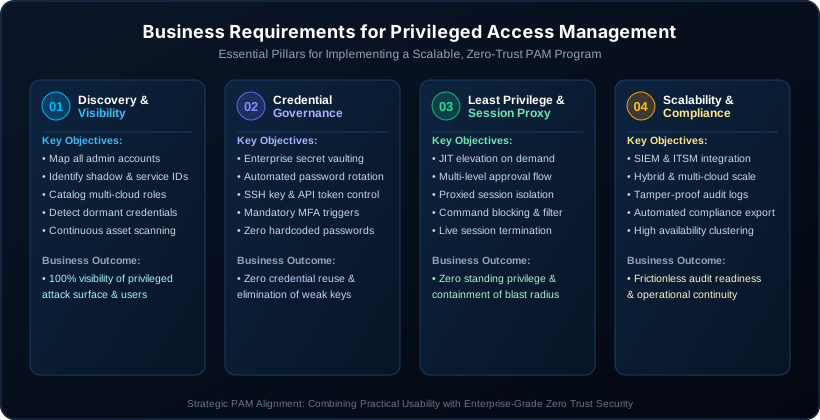
Every organization has different security needs, but several business requirements for privileged access management are common across industries. Companies should first identify their privileged accounts and determine who has access to critical systems.
A strong PAM strategy should consider:
- Visibility into privileged users and accounts
- Secure storage and management of credentials
- Multi-factor authentication for sensitive access
- Role-based and least-privilege access controls
- Session monitoring and audit capabilities
- Integration with existing security tools
Organizations should also consider scalability. As businesses adopt new cloud applications and expand their digital infrastructure, PAM solutions must support changing business and security requirements.
PAM and Zero Trust Security
Zero Trust has become an important cybersecurity approach because modern organizations no longer operate inside a simple network perimeter. Employees, applications, cloud services, and devices may operate from multiple locations.
Privileged Access Management supports this approach by helping organizations verify and control access to sensitive resources. NIST's Zero Trust guidance explains that organizations should not provide implicit trust based solely on location and should perform authentication and authorization before access to enterprise resources is established.
This makes PAM an important component of a broader identity and access management strategy. The importance of privileged access management increases as organizations move toward cloud computing, hybrid work, and distributed technology environments.
Improving Compliance and Accountability
Security is not only about preventing attacks. Organizations must also demonstrate how sensitive systems and information are protected. PAM can provide detailed records of privileged activity, making it easier for security teams to investigate incidents and demonstrate accountability.
Session monitoring and audit logs can help organizations understand who accessed a critical system, when the access occurred, and what activities were performed. NIST guidance on privileged account management highlights the value of combining monitoring, auditing, and authentication controls to prevent unauthorized access and detect unapproved privileged activity.
For regulated industries, these capabilities can support broader compliance programs and internal security policies.
Choosing the Right PAM Strategy
Technology alone cannot solve every access security problem. Before implementing a solution, organizations should clearly understand their privileged accounts, critical assets, users, and existing security processes.
The business requirements for privileged access management should guide the selection process. A small organization may need a simpler approach, while an enterprise may require extensive integration with identity platforms, security operations tools, cloud services, and multiple business environments.
The goal should always be practical security. An overly complicated system that employees cannot use effectively may create new risks instead of solving existing ones.
Conclusion
The importance of privileged access management is difficult to ignore in today's cybersecurity environment. Privileged accounts can provide access to the most critical parts of an organization's infrastructure, making them valuable targets for attackers. By implementing effective PAM controls, businesses can reduce unnecessary permissions, improve monitoring, strengthen accountability, and limit the impact of compromised credentials.
The best PAM solutions support a wider cybersecurity strategy built around identity security, least privilege, and continuous verification. Organizations that understand their privileged accounts and define clear access policies are better positioned to protect their critical digital assets. In a world where access can be as powerful as a master key, controlling that access is no longer optional, it is essential.
Frequently Asked Questions (FAQs)
1. What is Privileged Access Management?
Privileged Access Management is a cybersecurity approach used to secure, control, and monitor accounts with elevated permissions to critical systems and data.
2. Why is Privileged Access Management important?
The importance of privileged access management comes from the high level of access privileged accounts provide. If compromised, these accounts can give attackers access to critical infrastructure and sensitive information.
3. What are the main privileged access management benefits?
Key benefits include stronger access control, improved monitoring, reduced credential misuse, better auditing, and support for compliance requirements.
4. What should businesses consider before implementing PAM?
Important business requirements for privileged access management include identifying privileged accounts, defining access policies, integrating with existing systems, and ensuring scalability.
5. How do PAM solutions support Zero Trust?
PAM solutions support Zero Trust by reducing implicit trust, enforcing stronger authentication, and controlling access to sensitive resources based on defined policies.


