Best PAM Solutions for Enterprises 2026: Your Complete Guide to Privileged Access Management
Discover the best PAM solutions for enterprises in 2026. Learn how privileged access management (PAM) protects critical systems, compares with PIM, and why OmniPriv leads in Pakistan.
In today's rapidly evolving threat landscape, privileged access management (PAM) has become one of the most critical cybersecurity disciplines for any enterprise. PAM is a cybersecurity framework designed to govern, monitor, and secure accounts with elevated permissions — including administrators, service accounts, DevOps credentials, and third-party access that, if compromised, can expose an entire infrastructure.
A PAM solution goes far beyond basic password management. It provides visibility, control, and automation to ensure only authorised users can access critical systems at the right time — and only for as long as necessary. Whether your organisation operates on-premises, in the cloud, or across hybrid environments, implementing the right privileged access management PAM solution is the foundation of a mature security posture.
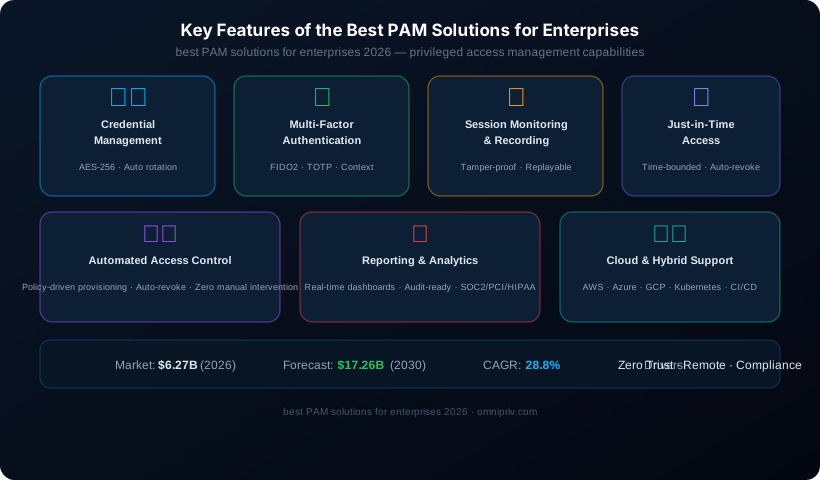
The global PAM solutions market, valued at USD 6.27 billion in 2026, is projected to reach USD 17.26 billion by 2030, growing at a compound annual growth rate (CAGR) of 28.8%. This exponential growth is driven by increasing adoption of zero-trust architectures, rising demand for continuous authentication, and expanding remote workforce security needs.
Why Enterprises Need a PAM Solution in 2026
Privileged accounts are the primary targets for cybercriminals. Attackers prioritise these credentials because they allow users or systems to bypass security controls, modify configurations, and access sensitive data repositories. Without a robust privileged access management solution, enterprises face:
- Unrestricted standing access that dramatically widens the attack surface
- Credential theft and lateral movement across the network
- Non-compliance with regulations such as GDPR, HIPAA, PCI-DSS, and SOC 2
- Insider threats from disgruntled or negligent employees
- Lack of audit trails, making incident response nearly impossible
By implementing one of the best PAM solutions for enterprises in 2026, organisations can prevent breaches before they escalate into full-scale incidents, enforce accountability across all privileged actions, and align with zero-trust principles.
PAM vs. PIM: Understanding the Difference
One of the most common questions security professionals ask is: what is the difference between PAM and PIM?
Privileged Access Management (PAM) focuses on managing and monitoring access to critical systems and data. It secures the session itself — controlling when access is granted, how it is used, and how it is recorded.
Privileged Identity Management (PIM) focuses on protecting identities — the accounts of highly privileged users such as administrators and superusers. PIM adds extra security measures, including time-limited access and role approvals, to ensure privileged accounts are used securely and responsibly.
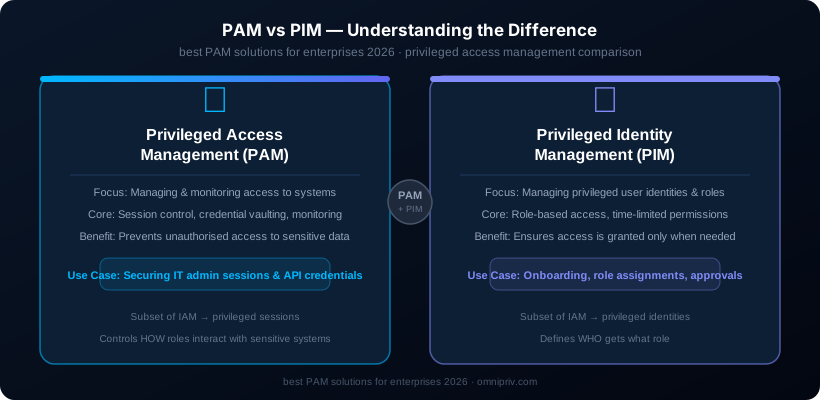
Primary Focus — PAM: Managing and monitoring access to systems **Primary Focus — PIM:** Managing privileged user identities and roles
Core Function — PAM: Session control, credential vaulting, monitoring **Core Function — PIM:** Role-based access, time-limited permissions
Key Benefit — PAM: Prevents unauthorised access to sensitive data **Key Benefit — PIM:** Ensures access is granted only when needed
Use Case — PAM: Securing IT admin sessions and API credentials **Use Case — PIM:** Onboarding, role assignments, approvals
Relation to IAM — PAM: Subset of IAM focused on privileged sessions **Relation to IAM — PIM:** Subset of IAM focused on privileged identities
While PAM and PIM serve distinct purposes, they work hand-in-hand. Most modern enterprise security strategies deploy both: PIM defines who gets what role, while PAM controls how those roles interact with sensitive systems.
Key Features of the Best PAM Solutions
When evaluating the best PAM solutions for your enterprise, these are the capabilities that matter most:
1. Privileged Credential Management
A strong PAM solution must securely store and manage all privileged credentials — passwords, SSH keys, API tokens, and certificates — using AES-256 encryption and automatic rotation after every use, ensuring a compromised credential cannot be reused.
2. Multi-Factor Authentication (MFA)
MFA adds an essential layer of security for every privileged session — hardware tokens (FIDO2), TOTP codes, or push notifications, combined with context-aware checks such as device compliance, location, and time-of-day.
3. Session Monitoring and Recording
Real-time monitoring and tamper-proof session recording allow organisations to track every privileged action and detect suspicious activities. This satisfies audit requirements under SOC 2, PCI-DSS, and HIPAA — and gives security teams the ability to replay any session during an investigation.
4. Just-in-Time (JIT) Access
Instead of permanent admin rights, Just-in-Time access grants a time-bounded, task-specific session. When the window closes, the credential is automatically rotated and access is revoked — dramatically limiting the blast radius of any credential compromise.
5. Automated Access Control
Policy-driven automation provisions access when a request matches policy and automatically revokes it when the session expires, with no manual intervention required.
6. Detailed Reporting and Analytics
Dashboards and scheduled reports covering account activity, rotation compliance, access review status, and anomalous behaviour give security teams the visibility they need and give auditors the evidence they require.
7. Cloud and Hybrid Environment Support
The best PAM solutions extend unified controls to AWS IAM roles, Azure service principals, GCP service accounts, Kubernetes clusters, and CI/CD pipelines — not just traditional on-premises servers.
Privileged Access Management in Pakistan
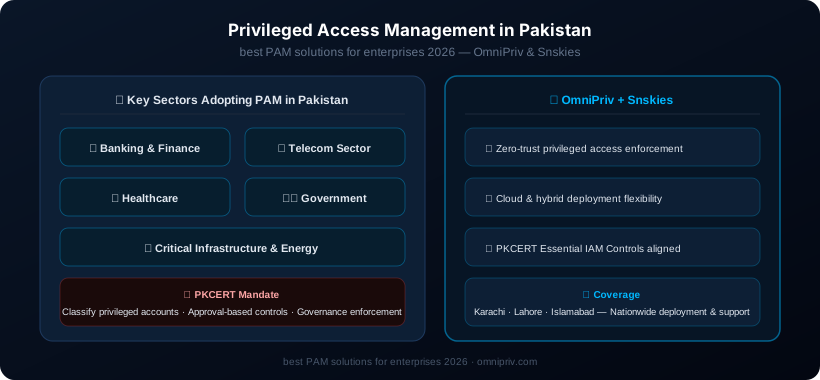
Pakistan's enterprise cybersecurity landscape is experiencing significant transformation, and privileged access management in Pakistan is now a top priority for organisations in the banking, telecom, healthcare, and government sectors. Pakistan's National Cyber Emergency Response Team (PKCERT) has published formal guidelines mandating that organisations classify privileged accounts based on business impact and enforce strict governance through approval-based access controls.
With growing digitalisation and a rising wave of cyber threats targeting critical infrastructure, Pakistani enterprises urgently need robust PAM solutions that offer advanced features, regulatory compliance support, and reliable local expertise.
OmniPriv stands out as a trusted provider of privileged access management in Pakistan, offering enterprise-grade security tailored to modern business needs, seamless cloud and hybrid deployment, and comprehensive support for compliance frameworks. Through its partnership with Snskies, OmniPriv helps organisations across Pakistan regain full control over privileged access, enforce zero-trust principles, and align with PKCERT's Essential Identity and Access Management Controls.
Whether your organisation is in Karachi, Lahore, or Islamabad, securing privileged access is no longer optional — it is a regulatory and operational imperative.
Frequently Asked Questions (FAQs)
What is privileged access management (PAM)? Privileged access management (PAM) is a cybersecurity framework that governs, monitors, and secures accounts with elevated permissions across an organisation's IT environment. It helps prevent credential theft, enforce least-privilege access, and maintain full audit trails.
What is the difference between PAM and PIM? PAM focuses on managing and monitoring access to critical systems, while Privileged Identity Management (PIM) focuses on managing the identities and roles of privileged users. Both are essential — PIM defines who gets access, and PAM ensures that access is secure and monitored.
Why does my enterprise need a PAM solution in 2026? With the global PAM market growing at 28.8% CAGR and cyber threats increasingly targeting privileged credentials, enterprises without a PAM solution face significant breach risk, compliance failure, and reputational damage. PAM is now a baseline requirement for cybersecurity maturity.
What is the best PAM solution in Pakistan? OmniPriv, deployed through Snskies, is widely regarded as one of the best privileged access management solutions available in Pakistan, offering enterprise-grade features, cloud-native deployment, and full alignment with PKCERT security guidelines.
See OmniPriv in Action
Talk to our team to see how OmniPriv addresses the challenges in this article for your specific environment.